
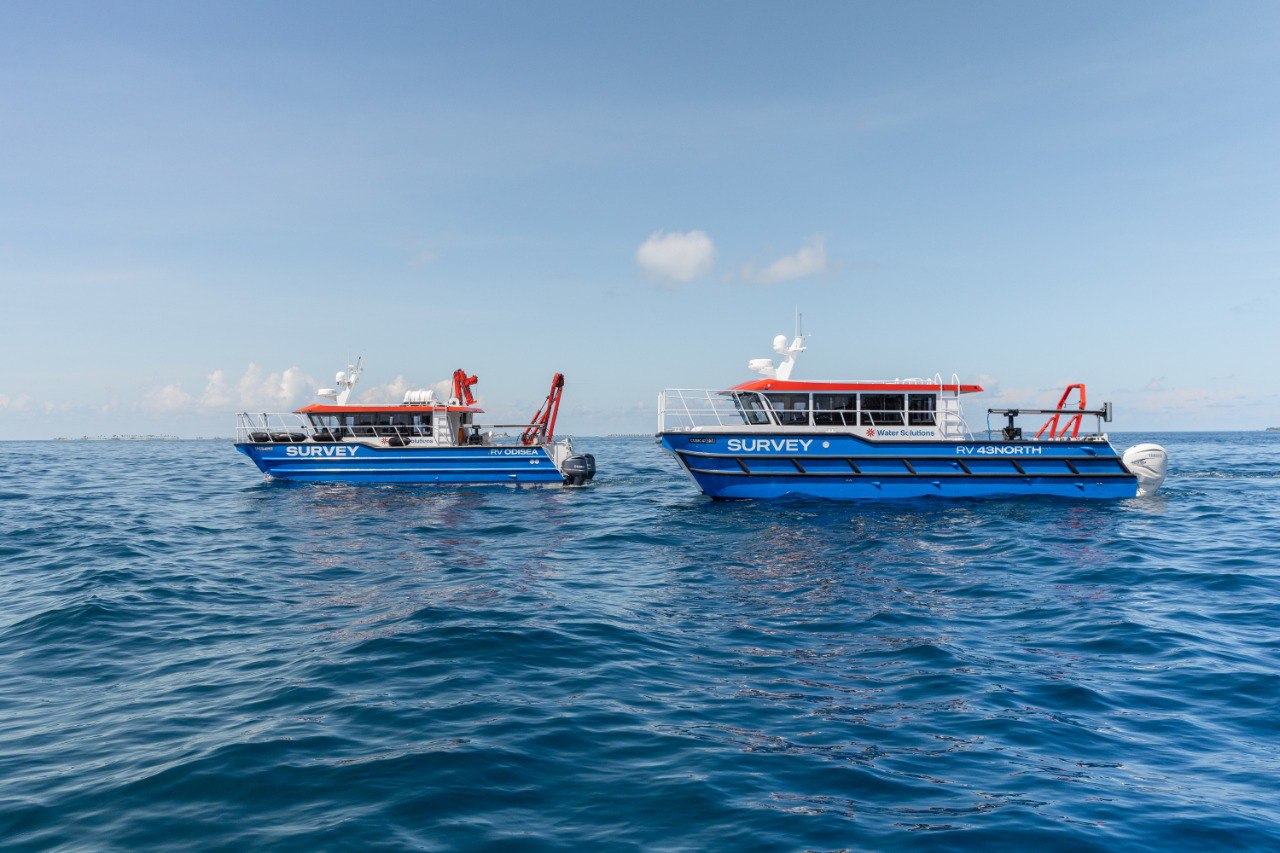
Most people associate the Maldives with its turquoise lagoons, coral reefs, and white-sand beaches. But beneath these familiar waters are features waiting to be discovered. In early 2025, one such feature came into view when a Maldivian survey team identified a previously undocumented blue hole in the waters just a short distance from Malé.
The discovery was made by Water Solutions Pvt Ltd, a Maldivian company with over two decades of experience in hydrographic surveying, engineering, and environmental consultancy across the country. What began as a routine seabed-mapping survey in North Malé Atoll soon took an unexpected turn when unusual readings appeared on the team’s instruments.
While scanning the seabed from the company’s newly commissioned survey vessel, RV 43 North, a young survey technician, Anoof, noticed depth readings that did not align with the surrounding seabed profile. To verify the anomaly, the team conducted repeated passes over the area using a high-resolution Teledyne SeaBat T50-R multibeam sonar system.
The results confirmed what many divers and marine scientists hope to encounter but rarely do: a deep, near-vertical underwater sinkhole. Located close to Kudagiri Picnic Island, the feature was subsequently named the Kudagiri Blue Hole. Initial measurements indicate that the opening begins at approximately 60 metres below the surface, descends to around 140 metres, and has an estimated diameter of about 50 metres at its mouth.
Blue holes are relatively rare geological formations, believed to have formed thousands of years ago, particularly during periods such as the last Ice Age when sea levels were significantly lower than today. These structures can preserve ancient sediments, fossils, and chemical records, offering valuable insights into past climates, sea-level changes, and reef development over long time scales.
Following the discovery, Water Solutions shared preliminary findings with André Droxler of Rice University, whose research has proposed alternative interpretations of Maldivian atoll formation that differ from the classic Charles Darwin atoll subsidence theory. While further study is required, the Kudagiri Blue Hole may contribute useful data to ongoing scientific discussions about how coral atolls in the Maldives evolved.
As the significance of the feature became clearer through repeated survey passes, the team shifted from routine mapping to detailed documentation. High-resolution bathymetric data were used to generate three-dimensional models of the feature, and a modified Blue Robotics BlueROV2, adapted by Water Solutions, was deployed to visually record the structure of the hole in a controlled and safe manner.
Globally, blue holes are regarded as sites of significant scientific interest. Some host unique marine ecosystems, while others preserve sediment layers that record environmental conditions spanning thousands of years. For the Maldives, discoveries such as this provide an opportunity to deepen understanding of reef growth, lagoon dynamics, and long-term responses to climate and sea-level change.
Beyond its scientific value, the Kudagiri Blue Hole discovery is also meaningful in a local context. It reflects a broader shift taking place within the Maldives, as more Maldivians enter fields such as hydrography, environmental surveying, and marine science, and increasingly complex marine investigations are carried out by local professionals using nationally operated vessels and advanced instrumentation. The fact that this feature was first identified by a young Maldivian surveyor underscores the growing depth of national expertise and the country’s expanding capacity to explore and understand its own oceans.
Further research will be needed to determine the age of the Kudagiri Blue Hole, the nature of any life it may support, and the stories preserved within its sediments. But even at this early stage, the documentation of the feature serves as a reminder that the Maldivian seascape, despite decades of study, still holds significant unknowns.
For a country renowned for the beauty visible above the waterline, findings like this reinforce an equally compelling truth below it: the Maldives’ underwater world remains rich in scientific promise, and Maldivians themselves are increasingly at the forefront of uncovering them.
 Advertisement
Related Articles
Govt Launches Study on Renewable Energy for Sustainable Transport Network
March 29, 2026
Bank of Maldives Partners with Visit Maldives to Launch Swipe as Official Digital Wallet for Tourists
March 6, 2026
Maldives, OPEC Fund Deepen Development Ties with New Strategic Partnership Framework
January 23, 2026Latest News

Fitch Upgrades Maldives Sovereign Rating to ‘CCC‑’ as Default Risk Eases
10 min read
Maldives Govt to Ban Social Media Access for Children Under 16
10 min read
Maldives Tourist Arrivals Rebound in May as Airlines Resume Routes
10 min read
UK Suspends Import Tariff on Maldives Fish Products
10 min read