The Maldives may be a small nation but its presence in the global context is not small. Being one of the most sought after destinations in the world, it is the far-flung dream vacation that everyone dreams of while others make it a reality. For an economy long reliant on tourism and imported expertise, the Maldives faces a familiar dilemma: how to grow without scale, as it fits the definition of a small economy. One that is characterised not by income level but by a limited population, a narrow domestic market and a high dependence on a small number of sectors.
Economically, the country is more exposed to external shocks, more reliant on imported skills and capital, and structurally constrained in its ability to achieve scale. It is against this backdrop that Dhiraagu and SparkHub’s announcement of the Maldives’ first Generative AI Hackathon, GenAI Hack 2026, takes on wider economic significance and what it could mean for the nation in a technologically advancing world.
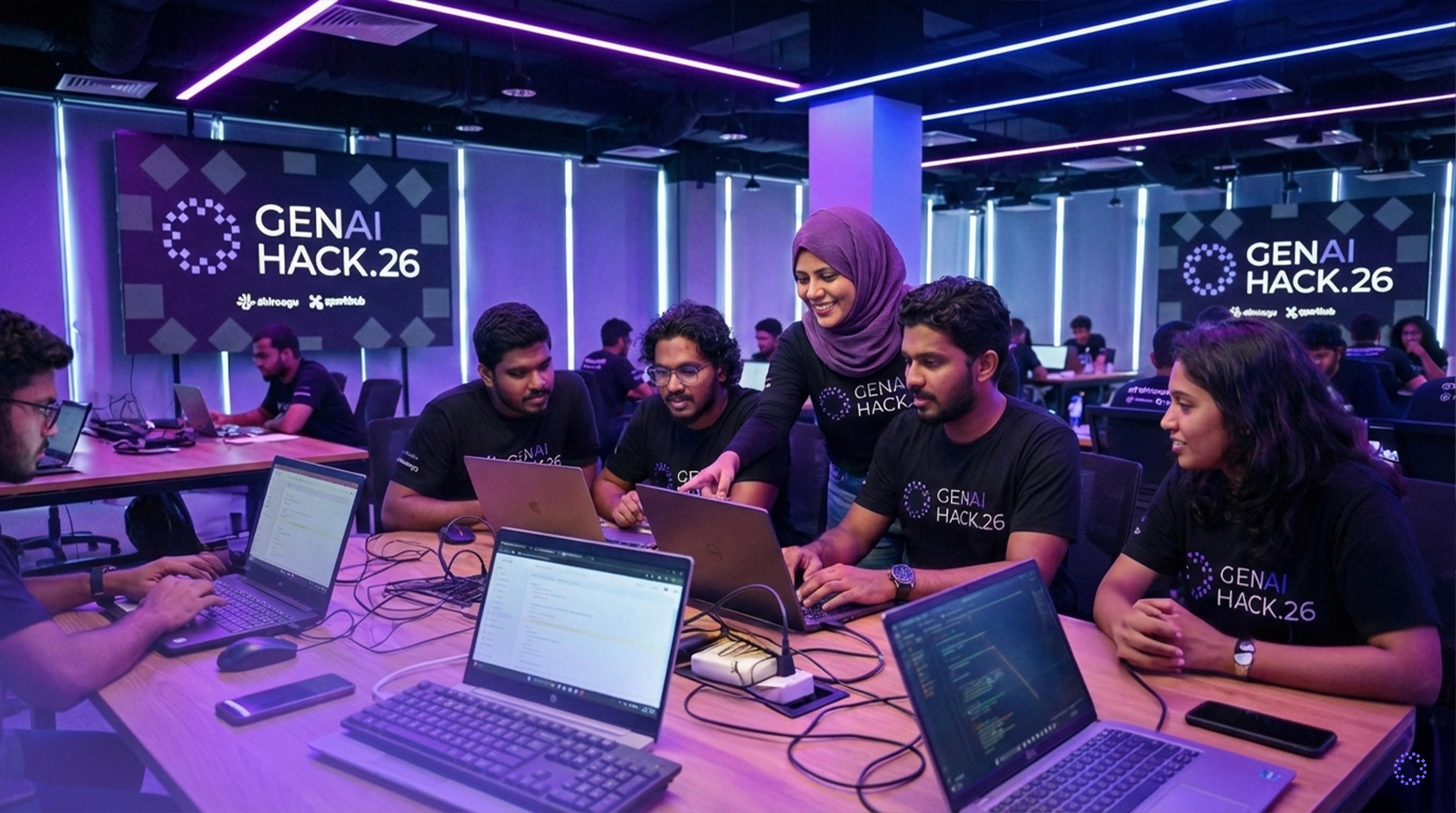
Scheduled for 6th to 8th February 2026, the hackathon brings together 12 teams and 52 participants for an intensive 48-hour sprint, challenging them to build, launch and publicly deploy AI-powered products. Unlike traditional innovation programmes that emphasise concepts or prototypes, GenAI Hack demands execution. Its rule is blunt; no shipping, no pitching. If a product is not live, it is not judged.
The economic logic is linear. Generative AI is beginning to erode one of the most persistent disadvantages of small economies; the high fixed cost of building sophisticated digital products. Tasks that once required large engineering teams can now be accomplished by smaller, less capitalised groups using AI-assisted development tools. With a population of just over 500,000, this compression of skills in the Maldives context is not merely efficient; it alters the economics of innovation itself.
Other small states have already moved in this direction. Estonia has used digital infrastructure to compensate for its modest population, building a globally competitive startup ecosystem despite its size. Singapore, though larger, has invested heavily in AI capability to maintain productivity growth in the face of rising labour costs. Smaller island economies such as Mauritius and Barbados have likewise begun positioning digital services and technology exports as a counterweight to tourism dependence.
GenAI Hack mirrors these strategies at a micro level. It follows an open-category format, requiring teams to develop entirely new solutions during the event itself, encouraging originality over incremental improvement. The focus reflects a broader shift in global startup economics; speed to market increasingly matters more than technical perfection, and real user exposure more than what’s on paper.
Participants will undergo intensive, curated AI sessions led by a panel of expert local mentors, covering ideation, development, deployment and product launch. Mentorship is embedded throughout the process, and an international generative AI specialist will serve as lead facilitator, importing global best practices into the local scene. This mix of domestic capability and external expertise echoes development models used successfully elsewhere, where knowledge transfer rather than self-sufficiency propels progress.
From a macroeconomic perspective, the initiative hints at a longer-term ambition; to cultivate exportable digital capabilities that are not bound by geography. Software scales cheaply. A viable AI product built in Malé can reach customers in London, Bangalore or Nairobi with minimal additional cost, a stark contrast to infrastructure-heavy sectors that demand large upfront investment.
Dhiraagu, the country’s leading telecommunications provider, has framed the hackathon as part of its broader commitment to digital capacity-building. “The rapid advancement of generative AI makes it increasingly important to actively engage communities in hands-on adoption of these technologies. This initiative reflects Dhiraagu’s commitment to equipping Maldivian innovators with the tools, skills, and confidence to build, experiment, and launch AI-driven solutions in real-world settings, while supporting community-led innovation”, stated Mirshan Hassan, Director Brand & Marketing Communications at Dhiraagu.
SparkHub’s leadership places the initiative within a global founder narrative. From the outset, this year has seen SparkHub grow exponentially, taking its programmes beyond national borders to Malaysia, where the company hosted Huddle Malaysia and laid the groundwork for initiatives like GenAI Hack. “Globally, founders are using AI to overcome skill gaps and dramatically accelerate product development,” said Hussain Jinan, CEO and Co-founder of SparkHub. “GenAI Hack was designed to reflect this shift by moving beyond conventional hackathons and placing emphasis on real product launches rather than conceptual demonstrations.”
The hackathon’s insistence on live launches mirrors practices common in startup hubs from Berlin to Bangalore, where market validation increasingly outweighs formal credentials.
Sceptics may note that hackathons rarely produce enduring companies. Structural constraints remain decisive on the access to follow-on capital, regulatory clarity and market size. Yet international comparisons suggest ecosystems are built incrementally. Estonia’s startup success did not emerge from a single intervention, but from repeated, compounding bets on digital capacity.
For the Maldives, the promise of generative AI lies not in replacing labour, but in amplifying it. By shrinking the distance between idea and execution, AI lowers the cost of experimentation, the essential raw material of innovation. Whether GenAI Hack produces a breakout company is almost beside the point. Its greater significance lies in signalling a shift in economic thinking from dependence on physical scale to confidence in intangible assets. In small economies like the Maldives, such signals matter.
by Ruby A
 Advertisement
Related Articles
Fitch Upgrades Maldives Sovereign Rating to ‘CCC‑’ as Default Risk Eases
June 3, 2026
Maldives Tourist Arrivals Rebound in May as Airlines Resume Routes
June 1, 2026
UK Suspends Import Tariff on Maldives Fish Products
May 21, 2026
Maldivian Launches Direct Flights Between Maldives and Australia, Marking New Era in Travel Connectivity
May 21, 2026Latest News
Maldives Govt to Ban Social Media Access for Children Under 16
10 min read
Bodies of Four Missing Italian Divers Found After Extensive Search Operation
10 min read
Search for Missing Italian Divers in Maldives Suspended After Coast Guard Fatality
10 min read
Maldives President Visits Tragic Diving Incident Site, Pledges Full Govt Support for Search Operations
10 min read