
Waiting for Home: Thousands of Homes Built, Yet Many in Need Remain Without One
When a man in his seventies stood before the President during a ward meeting and broke down while describing years of failed housing applications and the cramped conditions he lives in, the silence that followed was uneasy. Many in the audience lowered their heads, not in disbelief but in recognition. He said he had lived in Malé for forty years and had been trying to secure housing for most of that time, applying repeatedly and never qualifying on points despite living conditions that were plainly difficult. His emotion was not political. It reflected repeated disappointment over many years and the quiet fear of never having a secure place to call home.
That moment was not an exception. Across ward meetings in Malé, Hulhumalé, and Vilimalé, housing surfaced repeatedly as one of the most pressing concerns. Voices came from different backgrounds; Malé-born residents and those who have moved from their islands and have lived in the city for decades, yet the grievance was the same.
This frustration sits uneasily alongside the scale of housing development over the past fifteen years. Successive governments have overseen the construction of thousands of public housing units under various schemes, with entire residential districts rising, particularly in Hulhumalé. Yet for many long-term residents of the capital, especially those in lower economic tiers, housing insecurity has not eased. In some cases, it has intensified, leaving increased supply unaccompanied by a comparable sense of fairness.
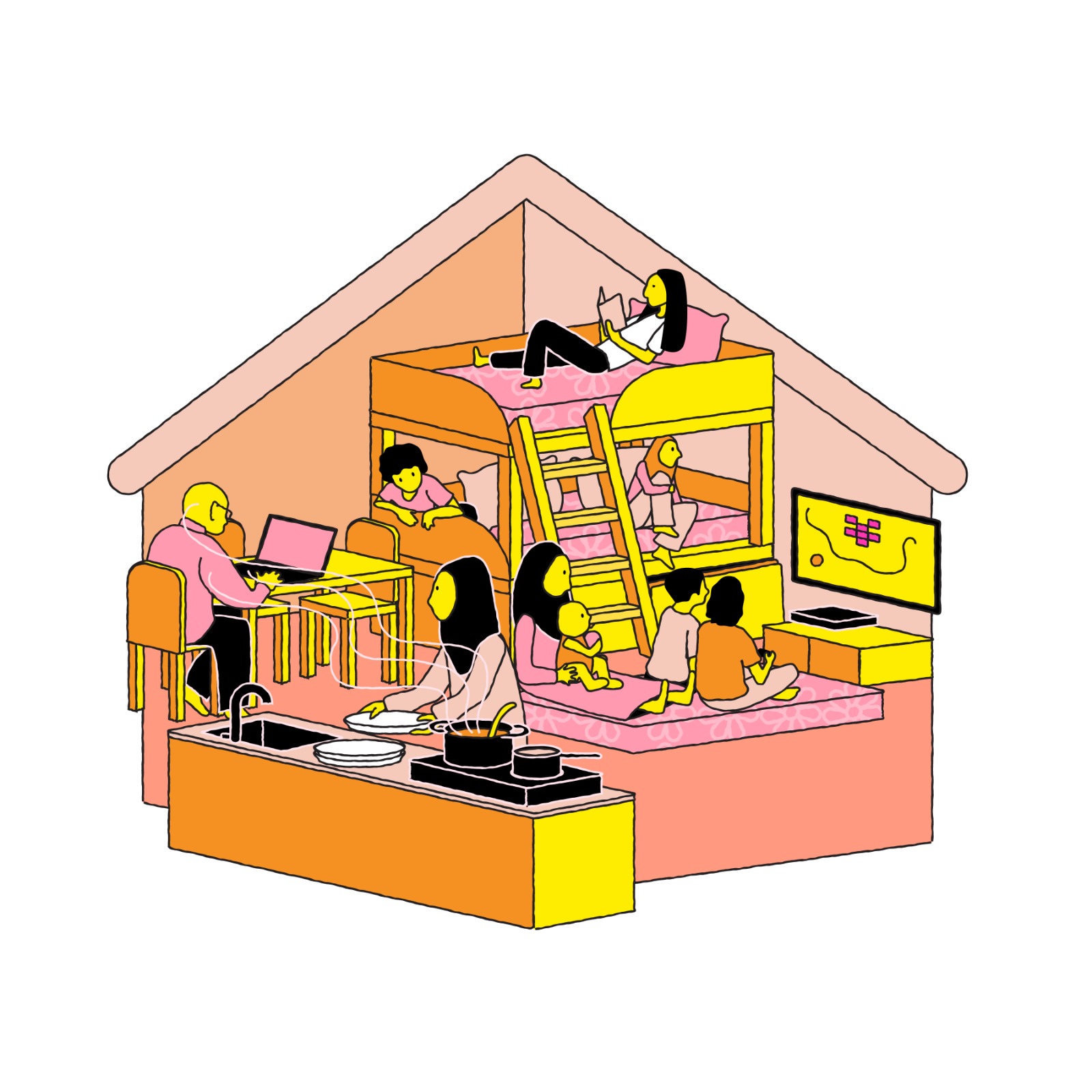
For many Malé-born residents, current hardship is not sudden, but inherited. It is the result of how land has been passed down over generations, each division leaving less space than before. Plots that once supported a single household have been shared, subdivided, and built upwards as families expanded. The consequence is visible today: multiple households compressed into small vertical structures, and in some cases entire families living within a single room of a few hundred square feet, where cooking, sleeping, and daily life unfold in the same confined space.
For residents who moved to Malé from the islands and have lived here for decades, hardship is often shaped by shrinking individual space and the rising cost of rented living. Many families settled in the city long ago, raising children in rented accommodation and adjusting constantly to what their incomes allowed. As those children grew up and began working, multiple families often continued to share the same living space to manage expenses. Those who seek privacy or separation face another constraint: rents that are unforgivingly high.
The man who spoke during the ward meeting had lived and worked in Malé for four decades, and his experience closely reflected the pattern faced by many residents who moved to the city from other islands. He described a life spent moving between rented spaces, adjusting constantly to what was affordable, and never reaching a point of stability. Despite applying for housing for much of that time, he was never assessed as eligible. His experience underscored a wider truth: hardship in Malé is not defined by origin alone, and long-term residence does not necessarily translate into security.
Across long-established Malé households and residents who moved to the city from other islands, outcomes increasingly suggest that access is shaped less by lived conditions than by proximity and connection. There are well-known cases where multiple members of the same family receive public housing units despite limited residence or existing assets, while others who have lived and worked in the city for decades remain excluded. Among families with long-standing ties to Malé, similar patterns appear in land allocation, where several plots or apartments are awarded within the same households even when substantial holdings already exist, leaving others in severely constrained living conditions with no realistic prospect of relief.
At the same time, not all awards follow any discernible pattern of advantage. Some allocations appear so inconsistent that it is difficult to understand why certain individuals were selected while others, in comparable or worse circumstances, were not. Despite the presence of formal criteria, outcomes often suggest uneven or careless assessment once priority allocations have been made. The result is a system that feels neither consistently biased nor reliably fair, but unpredictable in ways that further erode confidence in how need is evaluated.
Compounding this uncertainty is what has occurred during changes of government, especially in housing projects where the allocation process has not been completed. Lists are published and expectations set, but handover has yet to take place when administrations change. Reviews are then announced, often for legitimate reasons, given the way allocations are made and the fact that verification and award processes are left unfinished.
In practice, however, these reviews rarely bring closure for applicants. Criteria are revisited, lists reshuffled, and outcomes altered. Some names disappear, others appear. Those already on published lists remain suspended in uncertainty, while new beneficiaries emerge. For applicants, the distinction between review and replacement is rarely clear, but the effect is consistent: prolonged delay and the sense that familiar patterns of unfairness are simply reproduced under a different administration.
What happens after allocation often sharpens the sense of injustice. Newspapers have reported multiple instances of publicly funded apartments, designated as social housing, being listed for rent on open online platforms. Some have reportedly been leased as expatriate labour quarters, while registered beneficiaries live elsewhere. For families who have waited for years, submitting applications, declarations, and documents, this is not a technical breach or a grey area. It is an insult. Homes meant to provide relief and dignity are converted into income, while those in genuine need continue to rent, crowd, and wait.
Many residents had hoped that this pattern would finally change. Housing has featured prominently in every major political campaign, accompanied by assurances that longstanding wrongs would be addressed. For those who had waited years, sometimes decades, these expectations mattered. Yet even the most recent round of housing allocations has left many with the sense that familiar practices remain largely unchanged.
For those still waiting, the process is not merely administrative. Documents are gathered and resubmitted each time a new housing programme is announced. Points are calculated, declarations made, and expectations quietly rebuilt. Families wait through each cycle, knowing there may be no avenue to challenge the outcome, only the possibility of trying again when the next scheme appears. For many, this process represents hope repeatedly renewed, and just as quietly diminished when results are released.
Social housing exists to provide stability, dignity, and peace of mind, especially for those who have lived modestly and contributed quietly over a lifetime. Yet housing and land have, over time, also become powerful political instruments, often conceived, timed, and delivered as markers of achievement rather than as sustained policy. This helps explain why unresolved allocations, contested lists, and unfinished processes are repeatedly carried forward from one administration to the next. These reviews may be justified, but too often they reproduce the same patterns they claim to correct, entrenching a cycle that spans governments rather than belonging to any one of them.
For those who continue to wait year after year, the difference between policy, politics, and process is not theoretical. It is the difference between living with security, and living without it in the place they already call home.
 Advertisement
Related Articles
How the Maldives became a one-city country
January 14, 2026
Fitch Upgrades Maldives Sovereign Rating to ‘CCC‑’ as Default Risk Eases
June 3, 2026
Maldives Reaffirms Sovereign Foreign Policy Commitment, Urges Caution in Diplomatic Discourse
May 10, 2026
Maldives Settles USD 400 Million Dollar Swap, Secures New Indian Rupee Facility to Bolster Economy
April 24, 2026Latest News
Maldives Govt to Ban Social Media Access for Children Under 16
10 min read
Maldives Tourist Arrivals Rebound in May as Airlines Resume Routes
10 min read
UK Suspends Import Tariff on Maldives Fish Products
10 min read
Maldivian Launches Direct Flights Between Maldives and Australia, Marking New Era in Travel Connectivity
10 min read