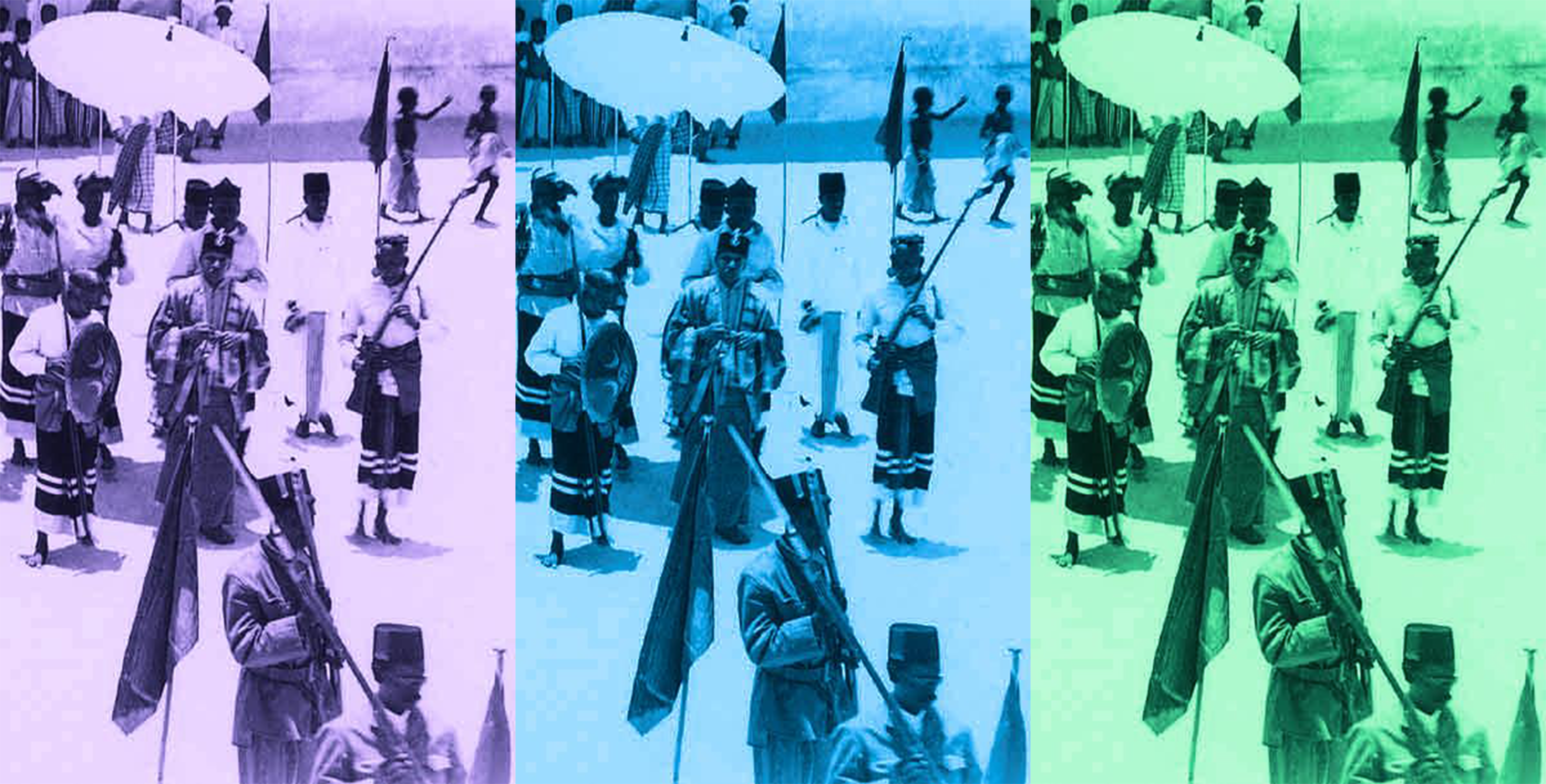
Our story takes place sometime in the 19th century in the Maldives’ capital, Malé, nestled within the verdure of the Sultan’s Palace.
Within the confines of the palace’s southern chamber, the Sultan is being dressed. Over a pair of trousers, their hems adorned with gold and silver thread, he dons his jubbah, a formal outer robe worn for ceremonial and religious occasions, elaborately embellished and flowing with long sleeves.
He steps into ornate, pointed-toed shoes, and attendants place upon his head the fagudi kolhu, a white ceremonial headcloth made from fine material. At the centre of its widest point sits the thurravaas, a flower-like ornament crafted from gold.
Across his body, from one shoulder to the opposite armpit, a multi-chain gold ornament with coin-shaped pendants is draped. This piece of jewellery, known as the fattaru, rests prominently against his attire.
The final element of ceremonial dress is then handed to him: a silk handkerchief.
From the palace grounds, the Sultan begins his ceremonial walk. As he steps through the doorway known as the Iskandhar Dhoraashi, the haiykolhu, the royal ceremonial umbrella, is made to bloom. A royal umbrella is never opened; it is always made to bloom, like a flower. The Dhivehi term for this act is folhuvaalun.
At the moment the umbrella blooms, seven shots are fired into the air. With the echo of the shots, the royal troupe of musicians begins to play the harubee, the music that accompanies this procession.
The sound unfolds in layers. The deep, steady beat of the beru drums anchors the pace. Woven through it without pause is the dhummaari, a flute-like wind instrument played in a continuous flow, its unbroken line binding the procession together. At measured intervals, the thaalhafili, a ceremonial trumpet, breaks through in regular, commanding blasts, marking movement, authority, and advance.
Leading the procession is the jadibu, the flag bearer, who carries the amaan dhidha, a white flag formed of three stacked triangular shapes.
Following him are the hangubeykalun, a troupe of bare-chested men wearing feyli, the traditional Maldivian sarong, over knee-length trousers, with handkerchiefs tied at their waists.
The hangubeykalun carry seven- to eight-foot-long wooden lances known as sileyha. Between the two lines they form, and behind the jadibu, the musicians maintain their cadence, filling the capital with rhythm and sound as the procession advances.
And as the procession moves through the capital, its purpose becomes clear: it is Eid, and the Sultan is on his way to attend the Eid prayer.
 Advertisement
Related Articles


Latest News
Fitch Upgrades Maldives Sovereign Rating to ‘CCC‑’ as Default Risk Eases
10 min read
Maldives Govt to Ban Social Media Access for Children Under 16
10 min read
Maldives Tourist Arrivals Rebound in May as Airlines Resume Routes
10 min read
UK Suspends Import Tariff on Maldives Fish Products
10 min read