Tourism was not Inevitable
The most recent exhibition at the National Art Gallery, at the time of writing, was of a genre that could not initially be defined. As I walked in during work hours with the intention of strategically...
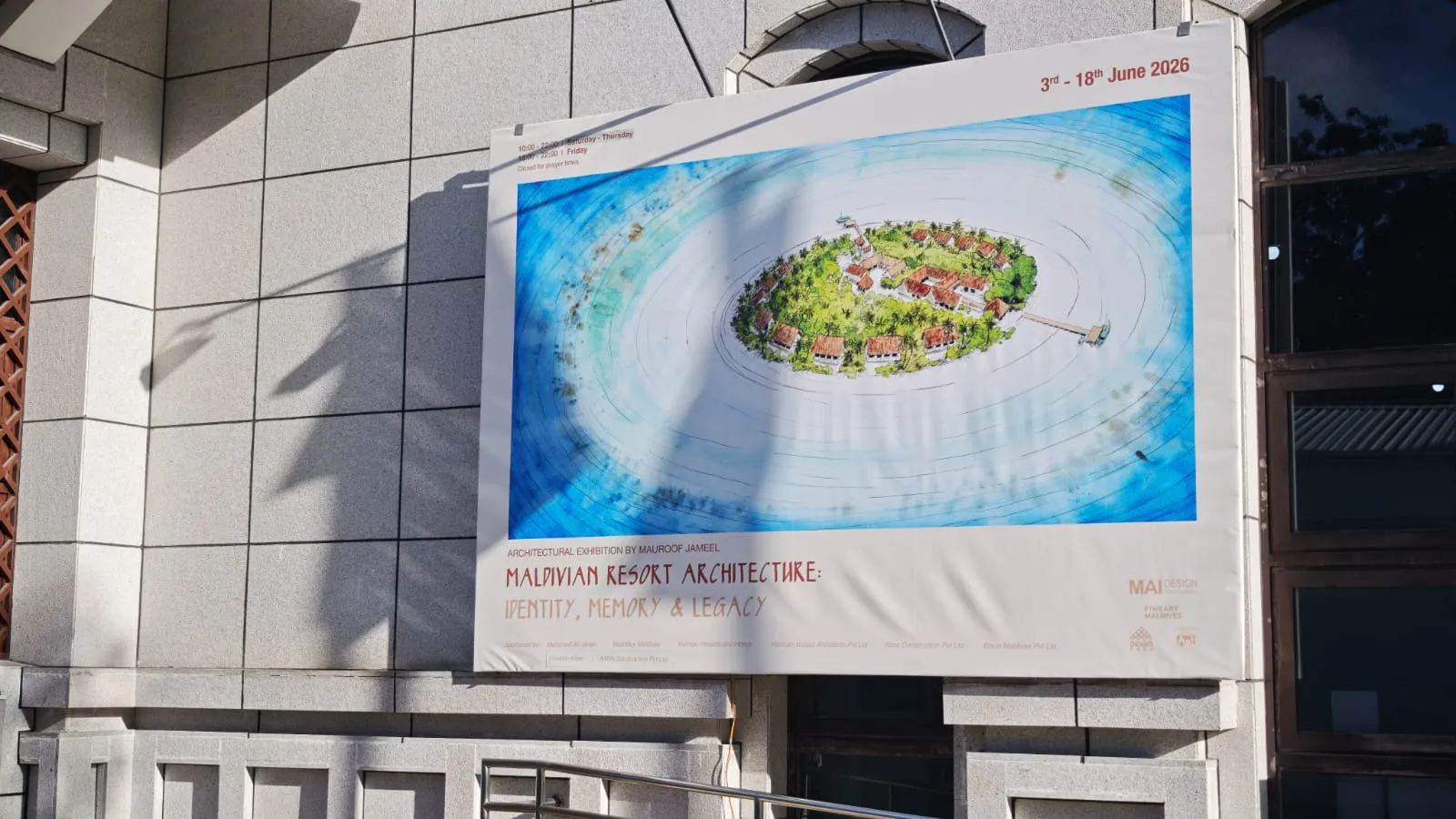
The most recent exhibition at the National Art Gallery, at the time of writing, was of a genre that could not initially be defined. As I walked in during work hours with the intention of strategically having the space and ambience for myself, I didn’t know what to expect. Art exhibitions at the Gallery have always been an evolving experience, where I might see a piece I had seen elsewhere but the moment and the context changes my perspective entirely. In the case of the “Maldivian Resort Architecture: Identity, Memory & Legacy” (a mouthful, but well-intentioned title), I did have some forecast of what I’d experience. However, what I had found was a tribute to reinvention.
It was a comfortable time to have gone there, only a couple with their energetic child were present as visitors while the team of curators (I like to assign that title to staff minding an exhibition as they do play even the slightest part in the ‘curation’ of the experience) warmly welcomed me. My specific albeit slightly pretentious way of enjoying an exhibition is to stay by a piece for longer than I would feel personally necessary, hoping that the visuals and the moment evokes something deeper, or better yet, peculiar, in my mind. So, I began this solo journey, hands tucked into my pockets and some abstract audio playing on my earphones and stood at the first wall.
What I thought was a strange use of the Papyrus font turned out to be the handwriting of the esteemed artist, Mr Mauroof Jameel himself, already drawing me into the care he must have taken for this. Reading through, I got the notions that nearly all writeups online now keep saying as well; the exhibition is intended to be more of a heritage piece, an attempt at preservation of architectural styles by showing the public the evolution of the Maldivian paradise product. Now of course by that time I hadn’t read the articles reporting on the exhibition yet, but the direction seemed clear enough. I realized that compared to some exhibitions I had visited of solo artists, there was a lot more attention given here for the way that each wall played a part in the piece being exhibited as well. This was apparent from the first segment, and taking note to appreciate this touch, I moved forward.
Until of course, I saw a QR code.
This exhibition did something I personally had not seen, or, in this case, heard before. Mr Mauroof had recorded himself narrating the overall description of each of the sections in the exhibition. Of course, that was the moment I had even realized the segmentation, noting that the first two-minute audio hosted online and easily played through my headphones dictated the story of the exhibits. Glancing around I noticed the tastefully incorporated 3D printed models as well. In an exhibition based on architecture, it would have been quite sorely missed to not be included in this day and age. Still, I went ahead with the experience, taking care to listen to each audio at the right space, to ensure I was immersed as the artist intended.
I walked out feeling refreshed. There was potential here for a coverage piece on the heritage of the Maldivian tourism industry and the roots of the Maldivian Paradise. I could have written another article about the evolution of the architecture, but the exhibition has already done that better than I could. Something was off. The more I thought about it, the more I felt it was not only redundant to report on these things, as the exhibition was literally structured to be a report in visuals, audio, and context, but it also began to feel reductive to me. Was it really the whole story? Or to be more precise, was it still true if I missed a very important component that Mr Mauroof had been trying to convey?
If I had taken the exhibition at face value as just a display of different types of buildings, I was not digging deeper into the intentions of the artist. Modern art demands that we also delve into how it made us feel. Mr Mauroof had combined both photographic history as well as his own renditions of the architecture he was speaking about. Even this was masterfully done with ink sketches and watercolours, capturing an essence inherent to the overall story that was being overlooked by simply reporting on what we were seeing on the first glance. Going back to the start, I realized the crux of it all.
Tourism in the Maldives was not an inevitability.
This is a fact that we have long since taken for granted, with over three fourths of our economy depending so heavily on this industry. We know that the Maldives is not the only destination blessed with natural beauty. We neither have rainforests, waterfalls, a wider biodiversity compared to similar regions, nor wildlife safaris, all these being the generic natural attractions that travellers in the tropics gravitate towards. What set us apart, and cemented the Maldives so solidly on the map, started with something Mr Mauroof mentioned on the very first segment of his exhibition, a phrase very easily missed if one didn’t give it the attention it deserved.
The Maldives adopted, and perfected, the One Island One Resort experience.
In the 1970s, this concept did not exist. It was the pioneering entrepreneurs who decided that they were not going to adapt to a market already growing globally, but they chose the approach that would define the Maldivian tourism industry at every stage. All their work that Mr Mauroof documented was not merely celebrating innovation.
It was a celebration of Reinvention.
The Maldivian resort model created privacy, exclusivity, environmental control, identity, security, and luxury all in one package. A tourist lands at the airport and barring the bureaucracy of immigration, they get whisked away into a world of their own. They were not simply paying for a room anymore. Their booking gave them access to an entire island, a concept no other country was offering at that time. However, it is only fair that I do give credit to the seascape around our islands for being a natural advantage, as the lagoons and house reefs were unique to quite an extent in comparison. Even then, that would not have been enough to have supplanted any competition in the tropical getaway category as we have done thus far. Furthermore, it wasn’t just the persistence of the private businessman that had allowed the tourism industry to have come this far, and Mr Mauroof had made this abundantly clear as well.
Government participation was key in how everything turned out over the last fifty years. Rather than dictating what a hotel island should become, the Maldivian approach was based on trust. It provided leases, legal certainty, access to more islands and infrastructure development to match the needs of the up-and-coming private hospitality parties. There was no manual before 1972, as to what a Maldivian resort should look like, and this let them trust the developers to be creative, to reinvent, to adapt, and even at times to experiment. Moreover, it was the dedicated development to the aviation industry that allowed the boom to really happen. Beyond laying the runway in 1960, the evolution to becoming the Malé international airport in 1981, negotiating with international airlines and firmly placing the Maldives on the routes across the Indian Ocean all but guaranteed that access was now unfettered and worth the long transits. The way Mr Mauroof highlighted the importance of this point now allowed me to appreciate the rest of the messages he’d embedded into his exhibition with more clarity.
Every stage of the industry required old assumptions to be re-examined and eventually reinvented. Adapting to the changes in conservation laws with the ban on coral stone mining in 1992, the shift from the simple island life experience all the way to the ultra-luxury concepts that no other tourist experience could ever come close to, and leaning into the trends of the ever-changing market such as being more photogenic for social media, are examples of this. The industry worked hand in hand with the government every step of the way, and the influence of this industry is seen in 1982. MATI, the Maldivian Association of Tourism Industry was the one voice and one round table that brought together the innovators, the regulators, and the representatives of the evolving industry. This was also a key message I felt I gleaned from the works exhibited at the Gallery. It gave me newfound appreciation for the bounties of an industry I had only attributed to geographical luck.
Art at the Gallery has always been layered depending on how we witness it. Regardless of the nuance and interpolation I am building upon the esteemed artist, I bank on the fact that the act of creating and showcasing one’s work as they do is with the intention that the audience takes away more than what’s on display. My experience reminded me of something that bordered on patriotism, but not as nationalistic. It was pride in our forebears, the ones who were persistent, the ones who had faith in them, and the ones who learned and stood on the shoulders of giants. Where we see a system that is well oiled, persistent through global pandemics such as Covid-19, conflicts reshaping airline routes from Ukraine to the upsets across the Hormuz just this year, and local governing policies that may do more harm than good on the onset, I began to see a legacy of reinvention.
In addition to this message, the expert brush strokes of Mr Mauroof Jameel added on something more, the more I looked at the interpretations of old architecture. It showed me that this million-dollar industry was not borne on the backs of mechanical industry grinding away into perpetuity. Nor was it a best-practice system that came with instructions that would never expire. It was carried on the wings of ideas sketched out, coloured in, and brought to life, before anyone knew it would take off to the skies. If we were to follow our current trajectory, the industry may continue to surprise us over the next fifty years, if only we keep in mind how far we’ve come.
Leave a comment
Comments
No comments yet. Be the first to comment!