The Maldives Has Changed. So Has Its Appetite for Dollars
Tourism brings foreign currency in. But a decade of changing lifestyles, new homes, resort expansion and public works has made the country far more expensive to run in dollars. If tourism earns the Ma...
Tourism brings foreign currency in. But a decade of changing lifestyles, new homes, resort expansion and public works has made the country far more expensive to run in dollars.
If tourism earns the Maldives so much foreign currency, why are dollars still scarce? Part of the answer can be found in how much the country has changed and how much the lives of the people within it have changed.
Think about what has become more common over the past decade: trips abroad, new homes, air-conditioners and appliances, vehicles, wider food choices, expanding resorts and construction on a scale rarely seen before. None of these changes is remarkable on its own. Added together, however, they have greatly increased the country’s need for dollars.
In 2014, tourism earnings and the cost of imported goods and foreign services were almost equal: $2.69 billion came in from tourism while $2.75 billion went out on imports. By 2024, tourism earnings had reached $4.79 billion, but the import bill had climbed to $5.34 billion. The difference was about $556 million.
Tourism is not the country’s only source of foreign currency, and imports are not its only overseas payment. But the comparison shows how rapidly the economy’s demand for dollars has grown alongside its main source of foreign earnings.
To understand why that gap emerged, we must look at how Maldivians were living, consuming, travelling and building.
The spending boom we rarely discuss
Every year, the national budget commands attention. It is announced, debated and dissected. Household spending receives far less notice because it is scattered across thousands of ordinary decisions: furnishing an apartment, buying a motorbike or an appliance, choosing imported food, paying school expenses or making a trip abroad.
Yet household consumption recorded the largest increase among the three broad streams of spending. Consumer spending rose from MVR 20.9 billion in 2014 to MVR 56.3 billion in 2024. Investment increased from MVR 15.2 billion to MVR 37.9 billion, while government final expenditure rose from MVR 10.7 billion to MVR 19 billion. The largest change, in other words, came from what households were buying, followed by what the country was building.

Look at household spending another way. Divided by the country’s resident population, it amounted to about MVR 52,000 per person in 2014. By 2024, it was approximately MVR 98,000.
That does not mean every resident personally spent that amount. Nor does it mean households imported goods worth MVR 56.3 billion: the total includes locally produced goods and services. But in a country that imports much of what people eat, wear, use and travel on, an increase of this scale inevitably adds to the demand for foreign currency.
Travel abroad offers a more direct example. Divide the country’s total spending on overseas travel by its resident population, and the average rises from about $516 per person in 2014 to $889 in 2024, an increase of roughly 72%.
This is a national average; it does not mean every resident travelled or personally spent $889. But think about how often members of your household travelled abroad in 2014, and how often they did so in 2024.
Part of the increase will reflect the higher cost of accommodation and other expenses overseas. Part of it is also likely to reflect more people travelling, or travelling more often. The figures cannot separate one from the other. What they do show is that overseas travel was drawing considerably more dollars from the economy.
Whether the journey was for a holiday, medical treatment, education, work or visiting relatives, the foreign-currency cost was real.
One new home creates many new demands
The transformation is easiest to see in Greater Malé. The expansion of housing, the rapid growth of Hulhumalé and the opening of the Sinamalé Bridge have changed where people live, shop and travel. The scale matters: in 2022, Malé, Hulhumalé and Villimalé were home to nearly 210,000 people, about 41% of the country’s resident population.
But the demand created by housing does not end when the keys are handed over. A new home must be lit, cooled and furnished. It needs fans, air-conditioners, refrigerators, washing machines, beds, sofas and kitchen equipment. A family moving into a new neighbourhood may also buy a motorbike or car.
The neighbourhood itself needs roads, water, sewerage, electricity, shops, schools and transport. Much of what goes into furnishing these homes and building the infrastructure around them must be imported. What begins as a series of ordinary household and community needs therefore adds to the country’s demand for goods, and for dollars.
Greater Malé’s expansion did not mean that the rest of the country stood still. Housing, harbour works, roads, utilities, reclamation, airport projects and private construction continued across the atolls. Spending in one part of the country did not replace spending elsewhere. One wave of development was layered on top of another.
Tourism expanded on two fronts
Tourism investment was expanding at the same time, and it was not confined to resort islands. Between 2014 and 2024, the number of registered resorts rose from 111 to 183, while resort-bed capacity increased from 24,031 to 44,689. Over the same period, the number of registered guesthouses climbed from 220 to 929. Guesthouse beds rose even more dramatically, from 3,199 to 14,659, more than four times the number available a decade earlier.
Those additional beds increased the country’s capacity to welcome tourists and earn foreign currency. They also created another source of demand for dollars. A resort requires buildings, furniture, generators, boats, kitchens, refrigeration systems and other equipment before it can receive its first guest. A guesthouse is much smaller, but it too must be built or renovated, furnished, cooled and equipped. Hundreds of such investments, spread across inhabited islands, add up.
Some of the import bill arrives before the first guest. A resort or guesthouse that opened in one year may have imported construction materials, machinery and furnishings during preceding years. Openings therefore cannot be matched neatly to the imports recorded in the same year.
Some of this initial investment may also have been financed by foreign equity or overseas borrowing. Where those funds paid foreign suppliers directly, the imports did not necessarily draw dollar-for-dollar from the country’s existing reserves. Once the properties opened, however, they created continuing demand for imported food and supplies, replacement equipment, transportation and services purchased from abroad.
Even so, the direction is clear. Tourism was not only bringing more dollars into the Maldives. Its expansion, through both resorts and guesthouses, also required a growing flow of imported goods and services.
Building a country from imported parts
Alongside private investment came the larger public projects: airports, bridges, ports, roads, water and sewerage systems, housing schemes and reclaimed land.
Capital spending did not increase in every category in 2024. But expenditure on roads, bridges and airports rose by MVR 1.6 billion from the previous year, reflecting work on projects including the Thilamalé Bridge, Velana International Airport and the Gulhifalhu reclamation and port development project.
These investments expand the country’s capacity and provide infrastructure that households and businesses need. But nearly every major project begins with a shopping list the Maldives cannot fill domestically: steel, cement, heavy machinery, electrical equipment, vehicles, fuel, engineering and specialist services.
Foreign financing changes how that shopping list is paid for, but not what must be imported. A foreign loan or grant may pay an overseas contractor or supplier directly, limiting the immediate demand on the Maldives’ reserves. The materials, machinery and services still enter the country as imports.
If the financing is a loan, it also creates a future demand for foreign currency. Interest and principal must eventually be repaid in dollars or another foreign currency. That is where the story of imported development begins to meet the story of public debt—a subject for another article in this series.
What arrived at the port
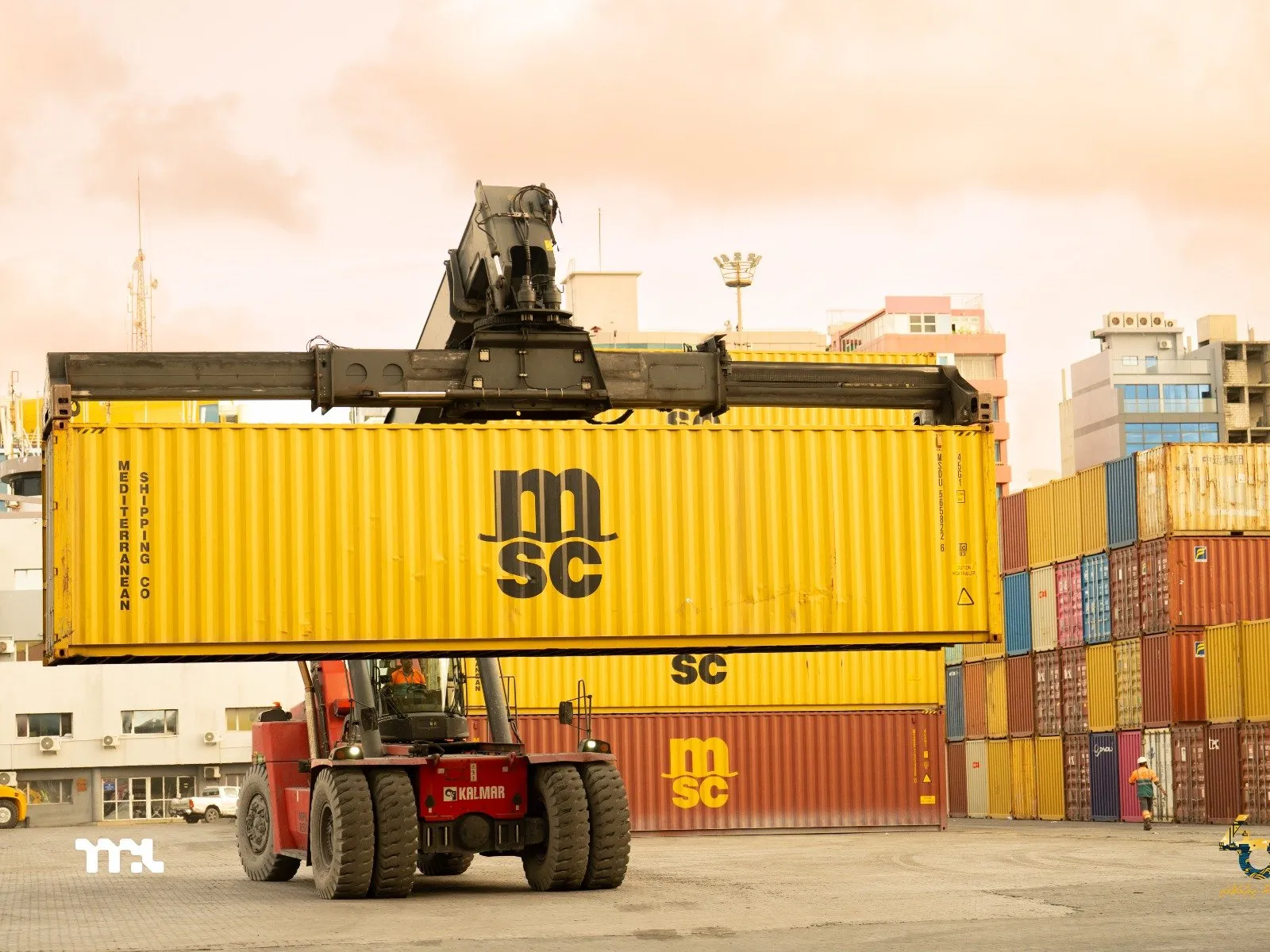
The changes visible in homes, tourist properties and building sites also appear in the goods arriving at the country’s ports.
Food imports rose from $408 million in 2014 to $755 million in 2024. Petroleum products accounted for another $754 million in 2024. Together, food and fuel cost the country more than $1.5 billion and represented about 44% of the entire goods-import bill.

Food and fuel remained the largest expenses among these categories. But some of the biggest percentage increases appeared in the goods used to furnish homes, move people and equip a growing economy.
Furniture, fixtures and fittings imports almost doubled. Transport equipment and parts increased by 142%. Machinery and mechanical appliances rose by 132%, while electrical and electronic machinery increased by 175%. Imports of wood, metal, cement and aggregates more than doubled, rising from $169 million to $352 million.
No Customs table can say which sofa went into a Hulhumalé flat, which refrigerator went to a guesthouse, which generator went to a resort or which shipment of steel was used for a bridge. The figures cannot assign every import to its final user.
But the broader pattern is consistent with the decade described in this article. The Maldives was importing the contents of new homes and tourist properties, the equipment required by expanding businesses and the materials used throughout a prolonged building boom.
It was not simply government spending
Public projects are large, visible and frequently debated, making it tempting to place most of the import bill at the government’s door. The figures point to a broader answer.
In 2024, private-sector businesses imported goods worth $2.7 billion, accounting for almost three-quarters of the total. That figure included $596 million imported by tourism businesses. Public enterprises accounted for another $889 million, while goods imported directly by the central government amounted to about $52 million.
These classifications must be read carefully. They identify the organisation that brought the goods into the country, not necessarily the person or project that ultimately used them. A private importer may supply food and appliances to households, equipment to a guesthouse or materials to a government contractor. Imports for public projects may also arrive through private contractors or state-owned enterprises.
Even with that qualification, the larger point remains: demand for imported goods was spread across the economy. Household spending had risen, private businesses were expanding, tourist properties were being built and operated, and public enterprises and the government were investing in infrastructure.
Together, they greatly increased the economy’s need for foreign currency, although overseas financing covered some investment-related imports without immediately drawing on the country’s existing dollar supply.
The imports that do not arrive in containers
Not every dollar spent abroad brings a physical product through the port.
Payments for imported services rose from $793 million in 2014 to $1.88 billion in 2024. By then, services accounted for just over 35% of the country’s combined bill for imported goods and services, more than one dollar in every three.

In 2024, spending by residents travelling abroad was the largest category, at $508 million. Transportation services, including the cost of moving goods and people, accounted for $498 million.
Close behind was a less familiar category: professional and management consulting services, at $462 million. That was almost one-quarter of the entire bill for services bought from abroad. The name is broader than it sounds. It does not refer only to consultants brought into the Maldives. It is a broad category that includes payments abroad for legal services, accounting and auditing, tax advice, business and management support, public relations, advertising and market research. It can also include management services provided by an overseas parent or affiliated company to a business operating in the Maldives.
The available figures do not show how the $462 million was divided among those services or which industries paid for them. What they do show is that a substantial part of the country’s dollar spending occurred through business services that most people rarely see or discuss.
These payments arise from the same expansion taking place across the economy. Imported goods must be transported. Residents travel. Tourist properties and other businesses purchase services from overseas. Companies and major projects require legal, financial, managerial and technical support.
As the Maldives economy became larger, busier and more connected, it did not only import more physical goods. It also bought far more services from abroad.
The dollar cost of the economy we built
None of this means that Maldivians should not furnish their homes, travel, develop tourist properties or improve the country’s infrastructure. Nor does it suggest that these imports were unnecessary. It means that each change carries a foreign-currency cost, one that attracts attention mainly when dollars become difficult to obtain.
Tourism brings dollars into the Maldives. But those dollars now enter an economy with many more ways to spend them abroad. They pay for the food on supermarket shelves, the fuel that moves people and goods, the appliances in new homes, the machinery on construction sites, the supplies used by resorts and guesthouses, and the foreign services required by businesses and public projects.
This is why the dollar question cannot be answered simply by pointing to tourism earnings. The country earns more foreign currency than it did a decade ago. It also spends more on consumption, travel, investment and construction.
The challenge is not to choose between development and dollars. It is to recognise the constraint: a country can earn more foreign currency and still face a shortage when its need for that currency grows just as quickly or faster.
The dollar shortage is therefore not only a story about how much foreign currency comes in. It is also a story about the economy the Maldives has become, and how many dollars that economy requires to keep going.
This article draws on Maldives Monetary Authority trade and balance-of-payments statistics, Maldives Bureau of Statistics expenditure and population data, tourism capacity figures and official fiscal reports to examine how changing consumption, investment and development have increased the country’s demand for dollars.
Figures are at current prices unless otherwise stated. Per-resident figures are national averages; household spending is not the same as household imports.
Leave a comment
Comments
No comments yet. Be the first to comment!