Maldives Tables MVR 59.7 Billion State Budget for 2027 Targeting Debt Sustainability and Long-Term Development
The Minister framed the expenditure plan as a strategic roadmap designed to reduce fiscal strain, maintain macroeconomic stability, and lay the operational groundwork for President Dr Mohamed Muizzu’s vision of transforming the Maldives into a fully developed nation by 2040.

Minister of Finance Hassan Zareer has presented a proposed state budget of MVR 59.7 billion for the fiscal year 2027 to the Parliament.
Addressing the parliament on Thursday, the Minister framed the expenditure plan as a strategic roadmap designed to reduce fiscal strain, maintain macroeconomic stability, and lay the operational groundwork for President Dr Mohamed Muizzu’s vision of transforming the Maldives into a fully developed nation by 2040.
The proposed outlay reflects a disciplined consolidation compared to the previous year, standing MVR 4.5 billion lower than the approved budget for 2026. Total government expenditure is projected at MVR 52.6 billion, comprising MVR 42.7 billion in recurrent administrative spending and MVR 9.9 billion in capital investments. Within capital spending, MVR 8.2 billion has been allocated to the Public Sector Investment Program (PSIP), with the government prioritising the completion of at least 70 percent of ongoing infrastructure projects.
Revenue Measures and Fiscal Consolidation
State revenue and foreign grants for 2027 are estimated to reach MVR 43.2 billion, marking an increase of MVR 1.4 billion compared to 2026. Medium-term projections place total revenue at MVR 46.6 billion in 2028 and MVR 49.7 billion in 2029. The Minister announced that no new taxes will be introduced and existing tax rates will remain unchanged. Instead, the administration will focus on narrowing loopholes, boosting compliance, expanding the Maldives Guest Information System, and introducing an electronic invoicing regime aligned with international best practices. Oversight of the fiscal mandate of the Maldives Customs Service will also be brought directly under the Ministry of Finance alongside legislative amendments to tax laws.
The budget anticipates an overall deficit of MVR 9.4 billion for 2027, equivalent to 7.3 percent of Gross Domestic Product (GDP), while the primary balance deficit is estimated at 3.4 percent of GDP. This follows an estimated overall deficit of MVR 7.6 billion (6.2 percent of GDP) in 2026. The fiscal roadmap targets bringing direct government debt down from 117 percent of GDP in 2027 to 116.3 percent in 2028 and 107.9 percent by 2029, with an overarching goal of reducing the fiscal deficit to 5 percent of GDP by 2028. Domestic financing for PSIP projects will be capped at 70 percent, and external debt interest payments will be maintained within 12 percent of total state revenue.
2026 Performance, Debt Clearance, and Economic Rebound
Reviewing 2026 fiscal performance, Minister Zareer underscored that the Maldives had navigated severe debt obligations without taking on additional debt to finance repayments. Debt service outlays reached MVR 10.4 billion by late October, with full-year debt repayments expected to conclude at MVR 11.7 billion. This substantial liquidation will lower debt service obligations in 2027 to MVR 4.5 billion, a turnaround that has bolstered sovereign credit ratings and reinforced confidence among international financial institutions. The government also managed 2026 expenditures without requiring a supplementary budget, absorbing major geopolitical shocks—including a war in the first quarter of 2026 that disrupted global aviation and caused tourist arrivals to plunge 23 percent during March and April. Fuel subsidies for 2026 are expected to close at MVR 3.8 billion before falling to MVR 3.2 billion in 2027 as global oil prices ease.
Economic growth, projected to settle between 0.6 percent and 1.8 percent for 2026 due to wartime shocks, is forecast to rebound sharply to between 3.9 percent and 6.8 percent in 2027, accompanied by a projected inflation rate of 1.0 percent. Official foreign reserves are projected to increase from USD 817.7 million at the end of 2026 to USD 907.2 million by the end of 2027. The tourism sector, designated to lead the economic recovery under the newly announced "Visit Maldives Year 2027" campaign, is targeted to draw between 2.28 million and 2.5 million visitors, yielding an estimated 14.5 million bed nights.
Commerce, Enterprise Support, and Productive Sectors
To stimulate local enterprise, the mandatory threshold for Goods and Services Tax (GST) registration will be raised from MVR 1 million to MVR 1.5 million starting January 1, 2027. Economic decentralization measures include funding for the Addu SME Trade Facilitation Zone and dedicated financing for youth startup enterprises.
Primary productive sectors will see major capacity upgrades, including an additional 11,400 tonnes of cold storage and 550 tonnes of daily ice generation for fisheries—featuring dedicated plants for reef fishing—as well as a yellowfin tuna packaging facility in Hulhumalé to assist small and medium enterprises in earning foreign exchange directly. Strategic import restrictions will also be placed on produce that can be cultivated locally to shield domestic farmers and reinforce food security.
Ports, Transport Logistics, and Greater Malé Connectivity
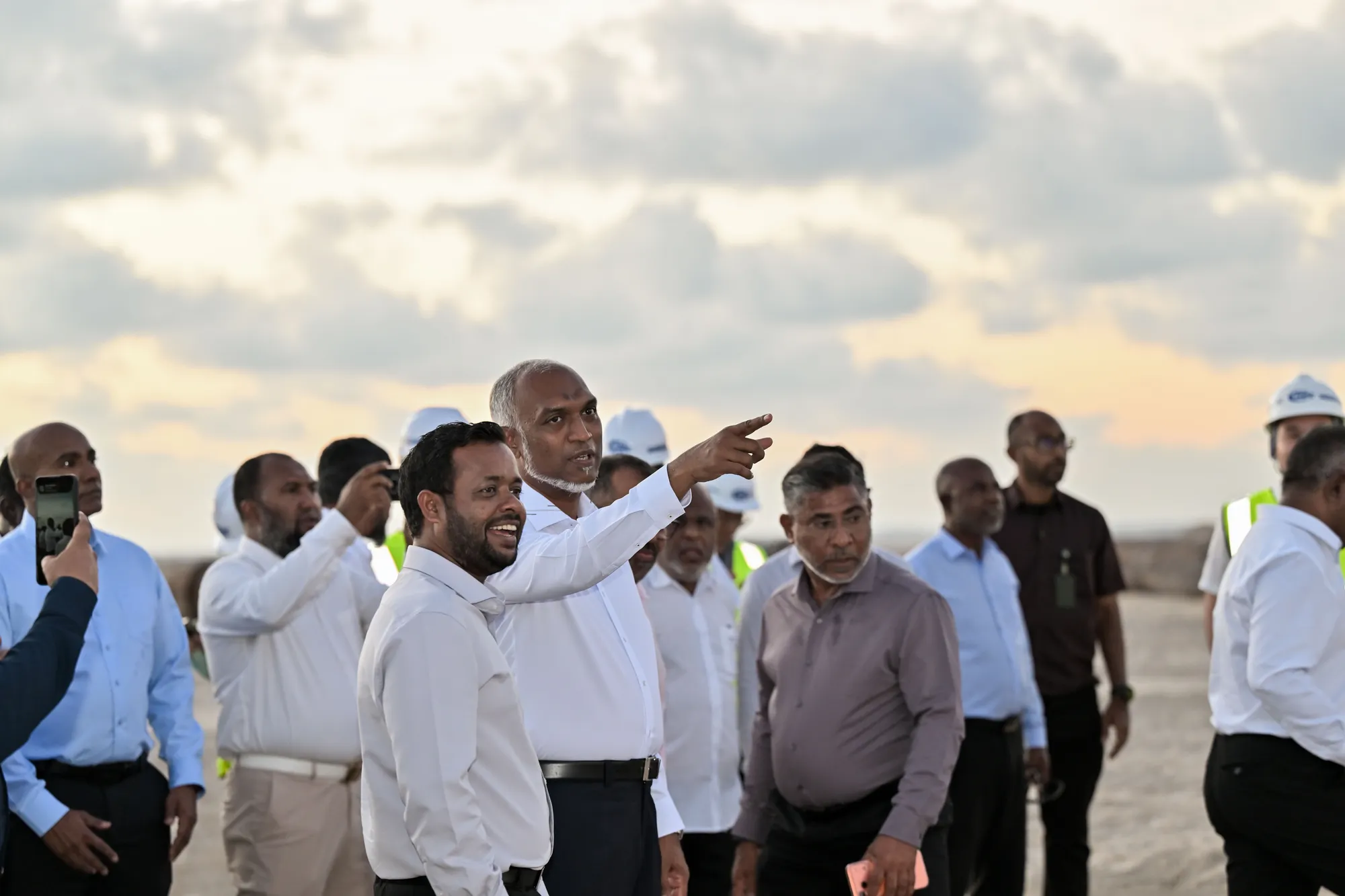
In logistics and transport, commercial operations at the new 60-hectare Greater Malé Commercial Port in Thilafushi are scheduled to commence before November 11, 2027. The deep-water facility will expand container handling capacity from Malé’s current 80,000 units to an initial 390,000 units—eventually scaling to 1.28 million units—while slashing container clearance delays from 9 to 14 days down to fewer than 3 days.
Completion of the Thilamalé Bridge by the end of 2027 will physically link the capital, Villimalé, Gulhifalhu, and Thilafushi, creating a unified transport and industrial spine. Additional traffic flow initiatives include the Greater Malé Transport Mobility Plan and an artificial intelligence-driven Smart Traffic Enforcement System.
Housing, Health, and Social Development
Addressing the national housing shortage, the 2027 budget allocates MVR 3.0 billion to housing development initiatives across the country. This includes MVR 750 million dedicated toward financing the equity component of home construction and purchase loan schemes for individuals who own land but lack building capital. Utilities and sanitation development across vacant residential plots on local islands will also be expedited.
Public health allocations total MVR 10.2 billion, highlighted by the establishment of the "Maldives Tertiary Hospitals Group" to raise medical standards across regional institutions. The sector will implement centralised procurement for medical consumables and expand the "State Pharma" system to ensure universal availability of essential pharmaceuticals at controlled costs, while establishing specialized local services including CT scans, MRI, dental, maternity, fertility, and decompression chambers.
In education, the Free Degree Program will continue with MVR 136.3 million, complemented by MVR 651 million in student loan facilities and the expansion of inclusive education infrastructure for children with disabilities. Social initiatives feature dedicated public-sector employment pathways for persons with disabilities, three new regional drug rehabilitation facilities, a "Gender Equality and Social Inclusion" (GESI) budget tracking mechanism, and the rollout of dedicated family picnic islands across every administrative atoll.
Digital Governance, Renewable Energy, and Cultural Heritage
The 2027 budget advances national digital transformation under "Maldives 2.0," funding a National Sovereign Cloud Data Centre and a digital identification smart ID card framework. On environmental sustainability, the administration will implement the Maldives Solar Development and Energy Storage Solutions Project under a Power Purchase Agreement (PPA) model. The 250-megawatt solar and battery storage initiative aims to reduce annual fuel consumption by more than 100 million liters, moving toward President Muizzu's pledge to meet 33 percent of national electricity demand via renewable sources by 2028.
National cultural projects include the construction of the Sultan Mohamed bin Abdullah Grand Mosque in Hulhumalé, designed to accommodate 10,000 worshippers to commemorate the 900th Hijri anniversary of the Maldives embracing Islam.
Concluding his presentation, Minister Zareer appealed to parliamentarians to pass the budget without delay, maintaining that the planned measures will deliver a stable, resilient fiscal platform capable of shielding citizens from global shocks while securing the financial foundation needed for generational growth.
Leave a comment
Comments
No comments yet. Be the first to comment!